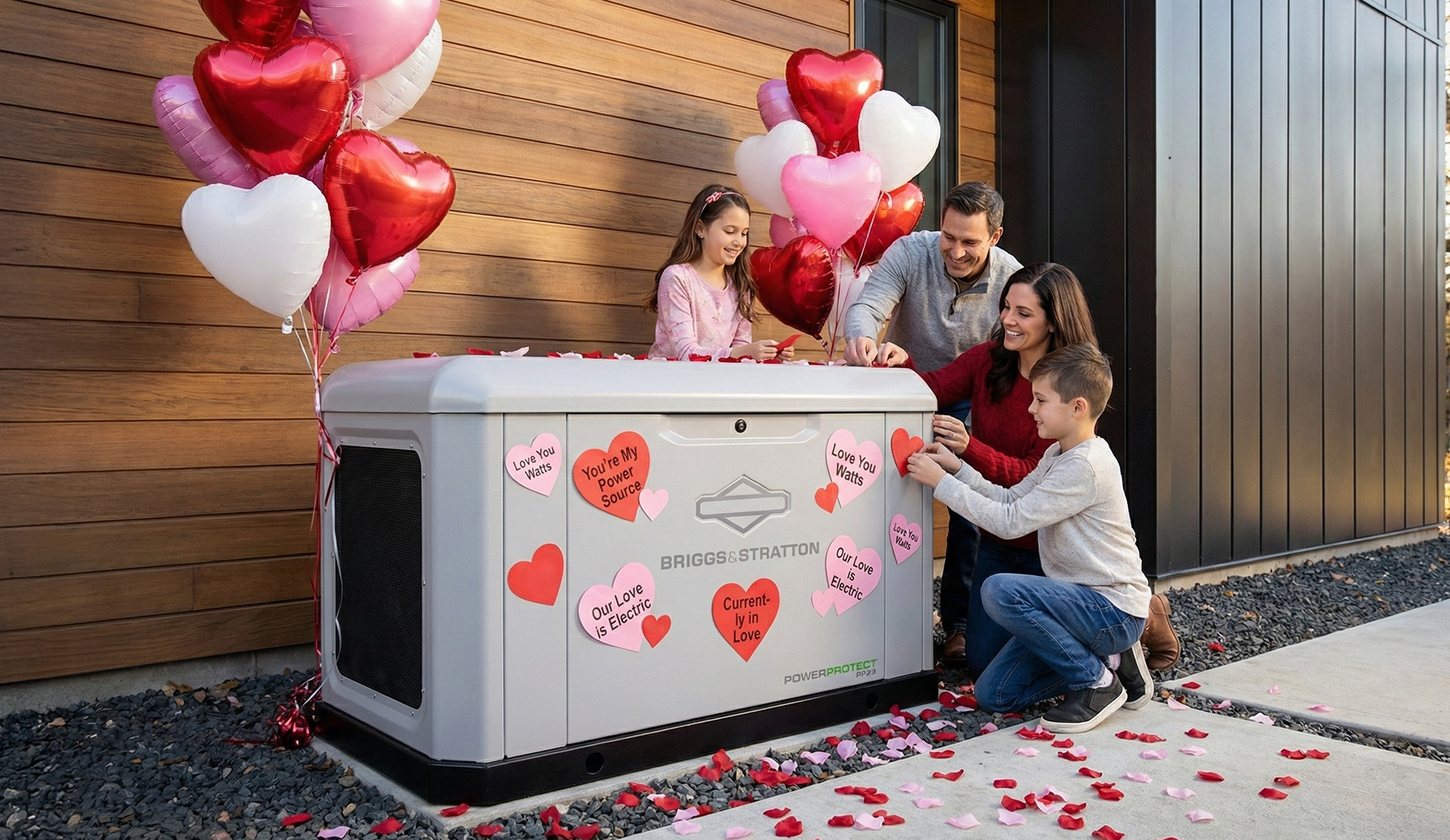
February is the month of "perfect matches," but while you’re picking out chocolates or planning dinners, Mother Nature often has other plans—like ice storms and unpredictable outages. When the grid goes down, the real heartbreak isn't a canceled reservation; it’s a cold house and a fridge full of spoiled food.
At Briggs & Stratton, we believe the key to a long-term relationship with your home backup system is right-sizing. If your generator is too small, it won’t handle the "spark" of your AC kicking on. If it’s too large, you’re paying for power you’ll never use.
Here is everything you need to know about finding "The One" for your home this February.

The Big Questions: What Homeowners are Searching For in 2026
To give you the best advice, we looked at the most frequent searches hitting the web this season. Here’s what you need to know:
1. "Can I size a generator based on my home's square footage?"
The Expert Answer: Square footage is a starting point, but it’s not the whole story. A 2,500 sq. ft. home with a gas furnace needs far less power than a 2,500 sq. ft. home with an all-electric heat pump and an EV charger. Sizing is about electrical load, not floor space.
2. "What is the difference between Running Watts and Starting Watts?"
This is where many "matches" fail.
Running (Rated) Watts: Either measured in watts (W) or kilowatts (kW), the continuous power needed to keep things going (like your lights and TV).
Starting (Surge) Watts: Also known as “motor starting,” this is the massive burst of energy required to kickstart large motors, such as those in your refrigerator, well pump, or HVAC system.
The Briggs Advantage: Our PowerProtect™ generators are engineered to handle these surges more effectively than other brands, ensuring your heavy-load appliances start smoothly every time. Simply check the generator’s specifications for the motor starting “kVA.” To ensure a perfect fit, your Briggs & Stratton dealer can analyze your energy usage and help you find the right size for your specific needs.
3. "Does natural gas reduce my generator's power?"
In general, the answer is yes. However, Briggs & Stratton’s NGMax™ technology ensures that if you are using natural gas, you get the highest power output available. A little known fact to most homeowners is that standby generators are mainly rated on their power output on liquid propane. The “26kW” on a generator means that generator is designed and tested to produce 26 kilowatts (kW) of power on liquid propane (LP). That’s because LP is a more efficient fuel source. We’ve engineered our generators to provide optimized performance on the fuel most homes already have - natural gas.
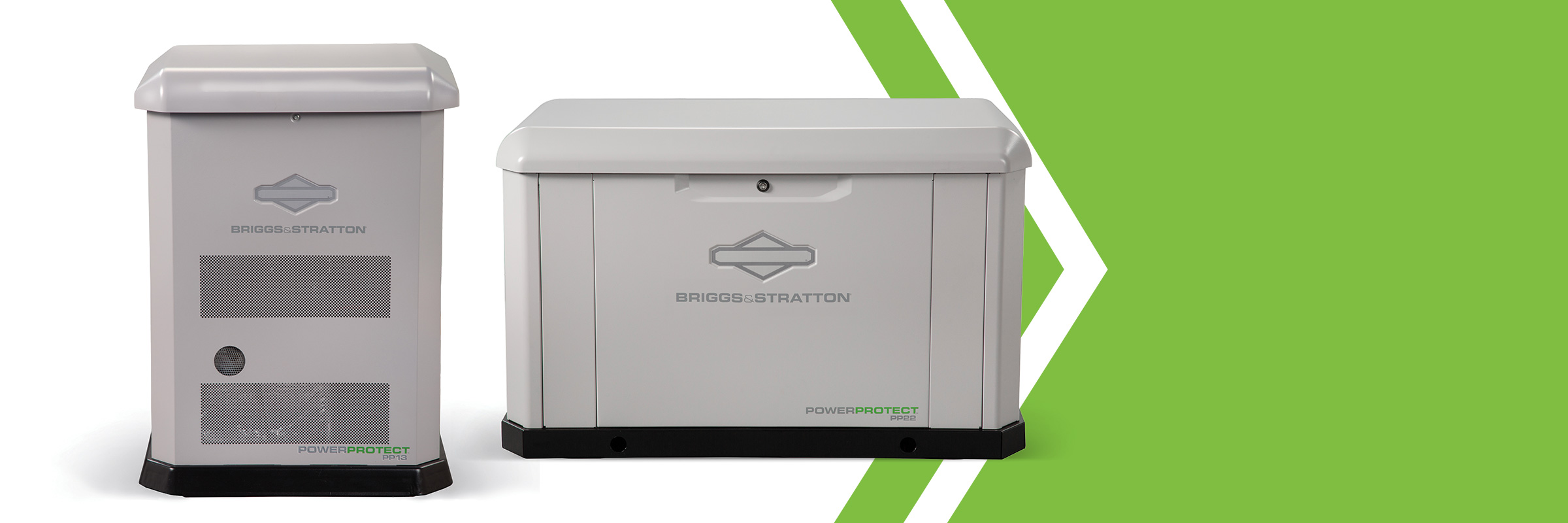
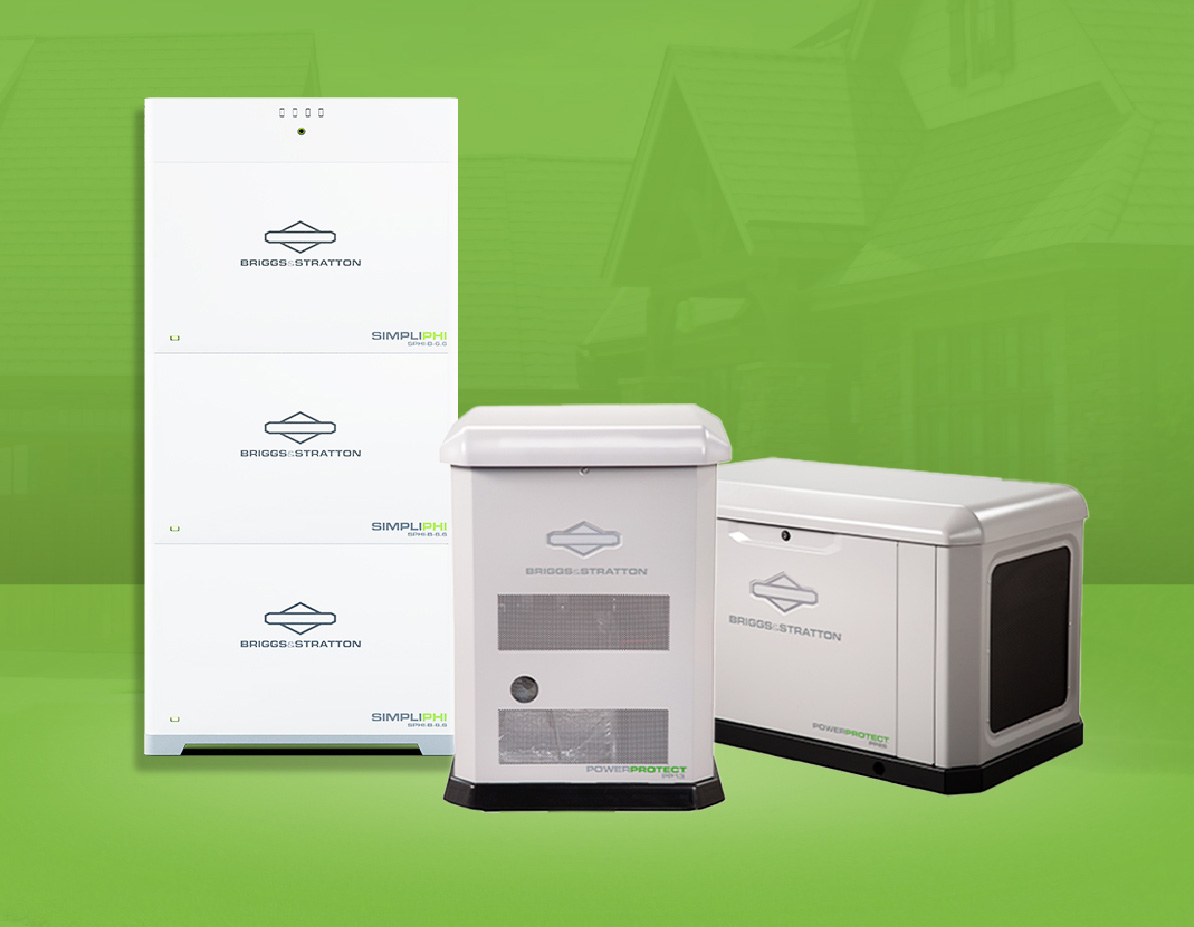
Meet the PowerProtect™ Lineup: Your Perfect Match
Whether you want to keep the kitchen running or your whole home, we have a model designed for your lifestyle.
The Best Match |
Why You'll Love It |
|
Essential Power |
13kW PowerProtect™ |
The smallest footprint in its class. Perfect for tight lot lines, it handles your fridge, lights, and sump pump with ease. |
Balanced Comfort |
18kW or 22kW PowerProtect™ |
These models provide reliable, unmatched power. Featuring NGMax™ for full power on Natural Gas and Eco-Cise™ for efficient testing, they offer more power and value than other leading generators on the market. |
Total Whole-Home |
26kW PowerProtect™ |
The powerhouse generator. It offers more motor starting power than other brands, handling AC units and high-end appliances simultaneously. |
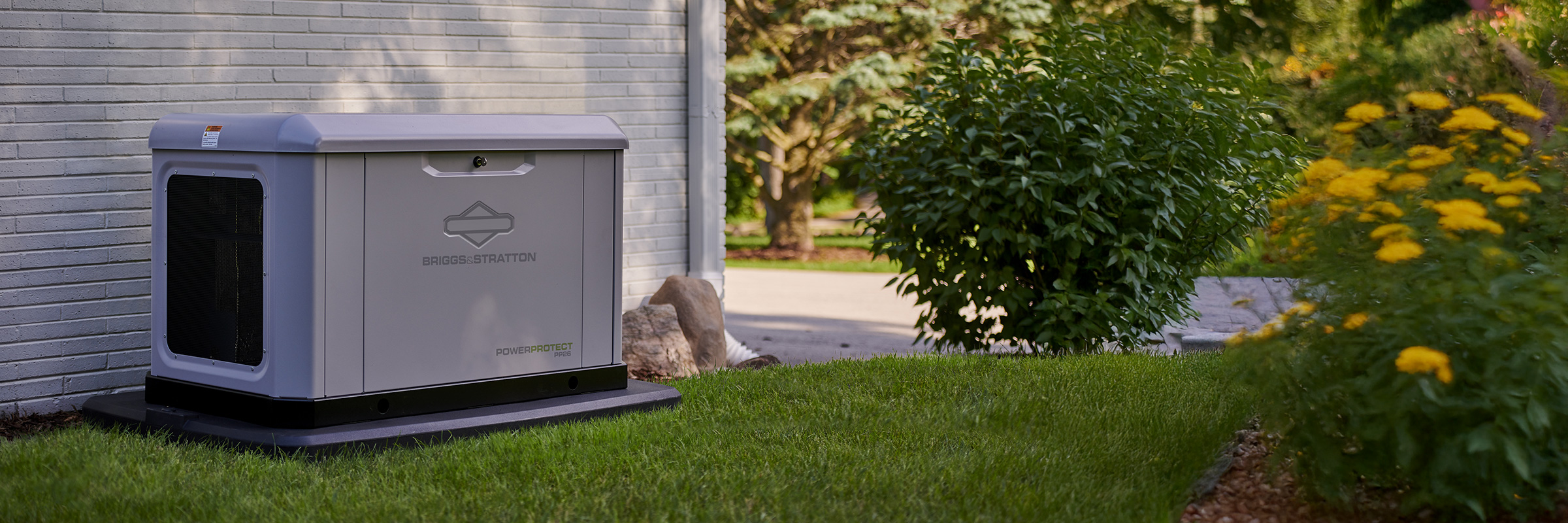
Why Briggs & Stratton is the Relationship That Lasts
When you choose a generator, you aren't just buying a machine; you’re buying peace of mind for the next decade.
NGMax™ Technology: While all standby generators drop in power output on natural gas, Briggs & Stratton standby generators deliver . You get the power you actually paid for.
The Best Warranty in the Game: Our 7-year comprehensive warranty covers mileage, labor, and parts. No hidden fees—just total protection for the full length of your warranty..
Compact & Quiet: Our units are designed to be discrete, running at noise levels comparable to a normal conversation, so you—and your neighbors—can sleep soundly during an outage.
Pro Tip: Don't guess your math. Use our Free Online Wattage Calculator to see exactly how much power your specific appliances need.
Ready to Find Your Match?
Don’t let the next winter storm break your heart. Whether you’re looking for a compact 13kW unit or the powerful 26kW whole-home solution, we have the engineering to keep your love (and power) flowing.
Request a FREE Consultation
Complete a short contact form to receive a no-obligation estimate.