 Over the years, Briggs & Stratton has demonstrated remarkable resilience and adaptability, evolving from producing complex six-cylinder engines to becoming a dominant force in the small engine market. As one of the nation's largest military suppliers, contributions during World War II underscored the capacity for large-scale production and technological advancement. Briggs & Stratton continues to makeover the small engine by developing those that boast greater fuel efficiency than industry averages and greening manufacturing processes with
 Expansion and Diversification
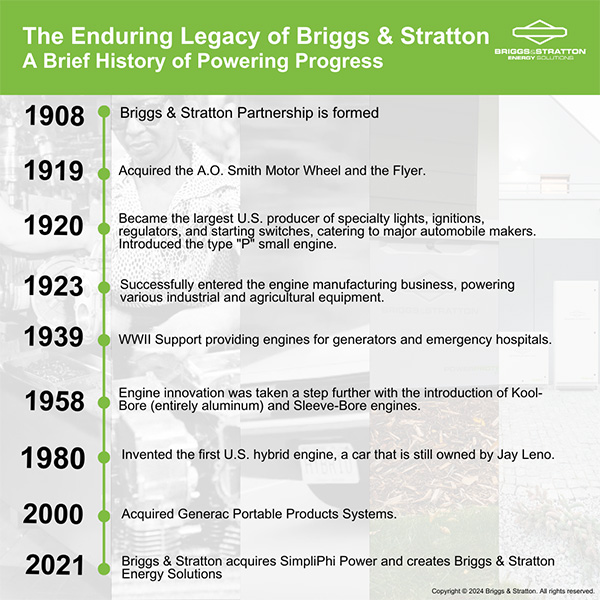
1920 - Became the largest U.S. producer of specialty lights, ignitions, regulators, and starting switches, catering to major automobile makers. Introduced the type "P" small engine.
1923 - Successfully entered the engine manufacturing business, powering various industrial and agricultural equipment.
1924 - Reincorporated in Delaware and entered the automotive lock business, becoming the largest producer of automotive locks within five years.
1928 - Acquired and then sold the Evinrude Outboard Motor Company. Stephen Briggs formed Outboard Motors Corp. with Ole Evinrude.
1931 - Successfully entered the engine manufacturing business with the Model PB engine and later the Model F series engine. These engines powered various industrial and agricultural equipment. Launched a best-selling engine for washing machines.
1938 - Introduced the Cushion Action Starter Drive, a new automobile self-starting mechanism.
World War II - Became one of the nation's largest military suppliers, producing a range of items from detonating fuses to engines for generators and emergency hospitals.